



Wiegand Interface: Security Analysis
Wiegand technology is widely used in legacy access control systems and can be part of the card–reader interface, reader–controller interface, or a binary bit format itself which is sent between the card – reader – controller. The wired communication taking place between the reader and the controller is the central mechanism in the access card system. The Wiegand devices or the card basically stores the employee’s identification number which is picked up by Wiegand.
In this article, we’ll be talking specifically about the reader–controller interface and how easy it is to read and a data stream on those lines and deduce the credential information out of it. Although the communication interface being wired is perceived to be secure, we will show here how easy it is to read the card credentials and how using wired data transmission techniques for access control security systems is highly unsafe.
Wiegand Interface Basics
Wiegand is an asynchronous protocol and has 2 physical wired connections running from the reader to the controller as data lines.
Data 0 – This line is Active low and will indicate a 0 being sent to the controller Data 1 – This line is also Active low and will indicate a 1 being sent to the controller
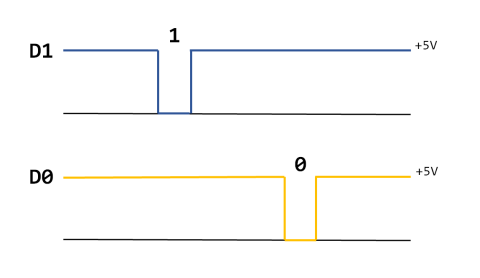
The HIGH here is 5V, but some interfaces can also have 12V as HIGH.
Reading the Card Data
For this, we have used a Mifare Classic 1KB card, but this will in general work for other card types as well. The user added in the system has the following card number

we probed the D0 and D1 lines of the interface using an Oscilloscope and got the following waveform.
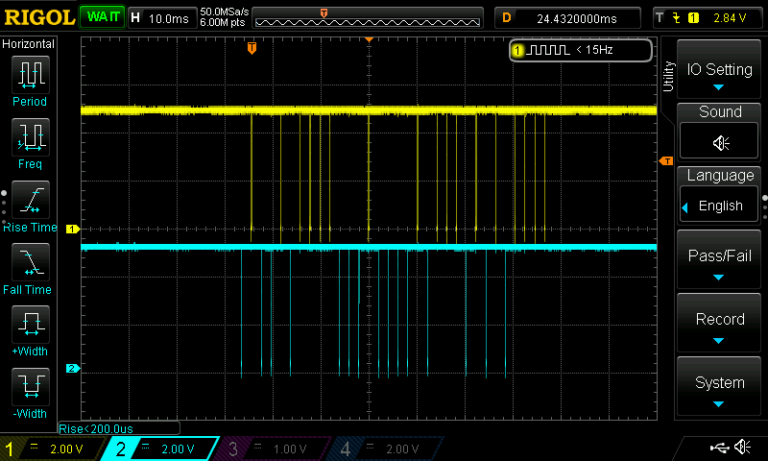
This is a zoomed-out snap of the entire transaction.
Yellow – Data 0
Blue – Data 1
As explained earlier both Data 0 and Data 1 will go low if a 0 or 1 is being sent respectively.
The bitstream is read from left to right and interpreted as:
10110100001110111101000101010000
Here we can note that the bitstream length is 32 bits.
Converting this to decimal gives us the following number:
3023819088
This number is the same as seen by the controller and saved as the credential ID of that user in the system.
Additionally, for Mifare cards, there is a UUID present for each card that is publicly visible. You can read the UUID by using a Smartphone or any other means. The card I used for this had the following UUID –
50:D1:3B:B4
This a 4-byte UUID in Hex format. Now if we look at the bitstream, we captured earlier and write it separating each byte –
10110100 00111011 11010001 01010000
Converting each byte to Hex we get –
B4 3B D1 50
This nothing but the UUID of the card, but in Little Endian Format.
Hence, we can see how the data is sent from Reader to the controller and how it can be easily decoded.
How wireless communication can be more secure

Secure Wireless Data Transmission
At Spintly we have adopted a fully wireless data transmission standard over a mesh protocol (BLE- mesh) where the readers communicate with each other and the Gateway over a wireless mesh communication protocol. This protocol uses encryption to secure the data which is sent over the air. Only the readers and Gateway have a required encryption key to make sense out of the data. This ensures full security of the data being exchanged. The highly powerful technology is the future of wireless access control systems.
In a Weigand Wired access control system, when you swipe your keycard or any access control device to unlock any door the Wiegand effect is taking place in the background and the security of such data transmission technique is prone to vulnerabilities.
BLE Mesh Wireless access control systems are highly secure and are also fast and easy to install. They reduce labor costs by eliminating wires and the need for hectic installations and updations.
This article shows how wired communication standards which are perceived to be secure are highly vulnerable and how wireless standards which are in general perceived to be insecure are much more secure and safe methods of transmitting data.
Future of Smart Lighting
We all have witnessed, how the latest trends of automation are affecting the lighting industry. Automation which was once done only in commercial/Industrial settings has now become a trend in smart homes. Alexa and Google home add in a fun factor and takes the smart home concept to the next level. The lighting industry itself has evolved over last 10 years from using the old faithful Incandescent bulbs to traditional fluorescent lights to compact fluorescent lights and now to LED lights. Within a mere 4 years period the lighting industry has been engulfed by LED lights. LED lights have truly transformed the lighting industry by reducing the power consumption by almost a factor of 10 as compared to the incandescent lights.
The lighting automation industry has traditionally been using wired solution to create a smart lighting environment, for example, Motion sensors have always been wired in the AC path of the lights which it controls. Dimmers have always been triac based dimmers which use a phase cut method to control the intensity of lights. Colored lighting was not such a norm until LEDs came in. The transformation to LED lighting has happened at such a rapid pace that the automation industry is still trying to adapt to this shift. This shift has created quite a few problems like, (1) Dimming of LED lights using Triac dimmer directly is not possible. (2) the existing wired infrastructure is mainly designed for the AC operated conventional lighting systems. The industry has reacted by developing retrofit solutions like dimmable LED drivers, Potentiometer based dimming etc. But with all these products developed inter-operability has been a challenge.
Meanwhile there has been a steady progress on developing wireless lighting control solutions and these are now showing a great promise. A few of the wireless technologies which have been adopted to lighting control are Wifi, Zigbee, Proprietary 2.4GHz RF, Sub-1GHz bands and Bluetooth. We at Mrinq Technologies think that Bluetooth might just win the race. Bluetooth has released Bluetooth 5.0 which greatly extends the range of Bluetooth devices. Line of site (LOS) ranges in excess of 1KM have been comfortably achieved using Bluetooth 5.0 hardware. This now makes Bluetooth a robust wireless carrier for indoor as well as outdoor applications where range has been a challenge.
Recently Bluetooth special interest group (SIG) has announced Bluetooth Low energy (BLE) mesh standard as an interoperable standard for lighting control. This standard allows any luminaire to talk to the next luminaire forming a mesh network of lights. The standard allows for 32K devices in a single mesh network and using the group feature this can be increased even more. The Mesh standard works on a subscribe and publish methodology and gives extreme scalability. It has features like “Friend node” and a “Proxy node” where something like a battery-operated Bluetooth temperature sensor can send data to a nearby Proxy node and that that data can be propagated over the lighting Mesh network allowing temperature control. Such sensors can last for several years on a single coin cell battery.
Deep power savings can be achieved by creating adaptive lighting environments. For example, using BLE-Mesh enabled motion sensors and ambient light sensors the light intensity can be intelligently controlled to maintain a constant lighting level throughout the office space. The lighting network will not only serve the purpose of smart lighting but also serve as a powerful data channel for passing sensor data and/or other relevant data to the cloud. Other applications of the lighting network could be precise indoor location tracking and navigation.
BLE-mesh in combination with Bluetooth 5.0 promises a range of wide applications in the areas of commercial lighting, Industrial IoT, Medial IoT, Warehousing, Airport management and Outdoor smart city applications. It can virtually help you get rid of all the Cat-6 cable we have been using fir wiring while constructing new building and in turn saving thousands of dollars. The adoption of this technology is still slow and we feel that once a tipping point is reached the market will make complete shift to wireless lighting.
Wireless interoperable lighting is the true future of lighting which will change the way we have been installing and using the lights.